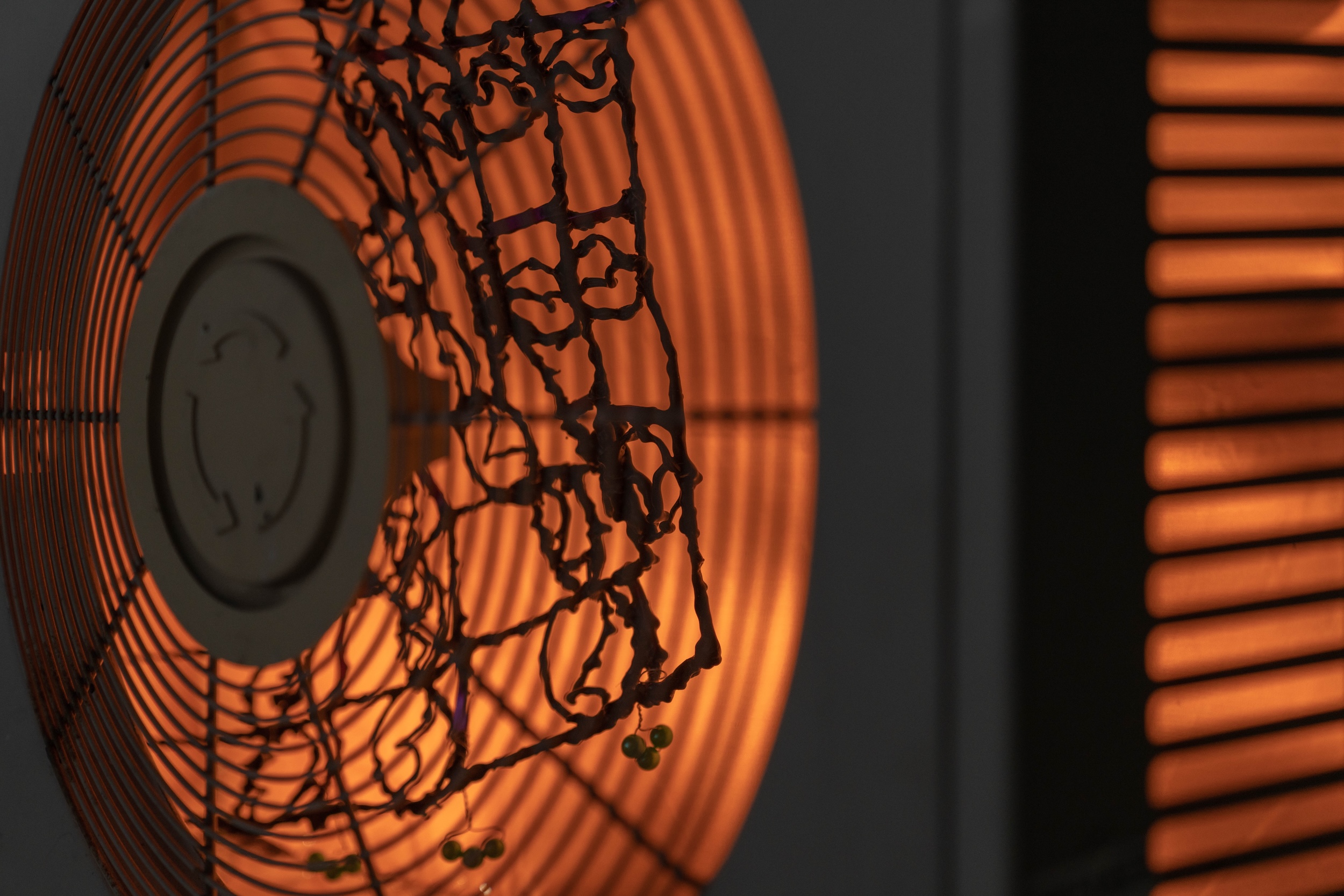
Evian Wenyi Zhang: Midnight Gathering
This post is also available in:
 简体中文 (Chinese (Simplified))
 English
Version 1
This is a nighttime gathering in a backstreet of the city. Narrow passages like this are usually home to outdoor air-conditioning units, where the recurring hum of machinery mingles with snippets of human conversation from within the buildings.
In a modern world driven by efficiency, these creatures have been given a simple, white exterior. They are expected to blend into their surroundings, concealing their presence and leaving only the sound of their breathing.
On nights of extreme temperatures, these machines work together to provide humans with comfort. While away from attention, they exchange news and settle disputes.
One by one, they take the floor, while revealing the true nature of their spirits.
It is said that genes of their ancestors—the hand fans—still run through their electric currents, surfacing only when humans are asleep. Occasionally, these ancestors join them, manifest their delicate fan leaves around…
/
Version 2
Evian Wenyi Zhang’s grid-based paintings give her a sense of freedom, allowing her to move beyond the constraints of pictorial subject matter and focus instead on how visual elements guide her attention, rather than the image’s content or meaning.
After selecting areas of interest from a source image, she reconstructs them through small units. The repetition and multiplication of these selected fragments create an incoherent yet compelling visual tabulation.
Though seemingly rational, the process places no restrictions on the choice of source images. The artist relinquished control over expression, instead, she becomes an explorer. The grid dismantles narrative while creating new space for imagination, allowing her to move freely from images to paintings, and from paintings to associations with other subjects and mediums. In this exhibition, for instance, patterns from paintings based on hand fans transforms into the “spirits” of air-conditioning units.
In recent years, Zhang has selected images of hand fans from Western museum collections, mostly dating from the 19th and 20th centuries. Beyond their functional purpose, the forms and designs of these hand fans also reflected the social status of their owners. The elaborate ornamentation of historical hand fans contrasts with the uniform white appearance of modern air conditioners, for which the artist feels a certain sense of sympathy.
Around the 1940s, large domestic appliances with simple white designs began to be referred to as “White Goods.” Beyond representing hygiene and order, their appearance was also intended to blend into their surroundings, receding from our sight.
In a world where attention has been commodified, content competes for the spotlight, while these mass-produced appliances seem to have withdrawn from this relentless competition. In Zhang’s practice, her experiments with attention open up new possibilities for perception. Through this process, she hopes to awaken the air conditioners, creating a space where their individuality can be unleashed, if only for a short while.